Saturday, July 30, 2011

Too Hot for Hot Wax


It's Summer! July 26th. The days will be getting slightly shorter now, but it is also so much hotter. Too hot for hot wax!


Some days are too hot to work upstairs in my studio so I move downstairs to the garage where there is shade and a nice cross breeze to work in. I like to get up early this time of year to enjoy the early morning coolness and the sunrise. It's also nice to get as much of the heat producing work done early. The mornings are cool and fresh. I'm thinking of gardens now and two new batik are pictured here, veggies in rain and veggies in sun.


My grey and calico friends are happy I'm doing my batik, as am I. You can see in these pictures my stretching table set ups. I have a compact wooden section for moderate sized pieces, you can see in the photo with me wearing green. This can be propped forward with bricks and very small pieces can be tacked in place for wax application. Fabric can also be stretched much farther back toward the wall to do very large pieces of fabric (see photo with the long batik tacked very high and at the bottom right a bricks in between that can create a very short section to work on small batik. Downstairs in the garage a different way of tacking up the fabric can be seen. I have moved down into the garage in order to be a bit cooler. The pan of hot wax still causes me to work in the evening and early morning. The drawback of course is the mosquitoes, gnats, moths and other miscellaneous flying creatures in the garage. Ironing has been moved outdoors for the summer and is done also morning and late in the day.


The photos also show me using the tjanting tool, a brass or copper bowl that has a spout and enables me to make lines of wax. There are different sizes of spouts that make smaller and larger lines. (See photo of my electric frying pan with full range of brushes and tjantings that I use.)The larger spout requires me to work very fast. In one picture you can see a cloth in my left hand. The cloth is there to can drops of wax from falling where they shouldn't. It doesn't stop flowing until all is used or it gets too cool. The larger spout has the most and fastest drops. At some point I will try a larger electric tjanting, but for now I dip the tjanting into an electric frying pan holding hot wax at a steady temperature. You can see another smaller pan that holds soy wax. Soy wax is a soft vegetable wax. It does not give as crisp, clear a line as my beeswax and paraffin mix. It also takes a little bit of dye into itself that gives light shades of color to the areas it has been applied to. Delicate and not as resilient as my other wax mix, it has an advantage of being able to be washed out of fabric in very hot water and detergent. Very hot is the key here.

The brush is shown applying wax as well. I have many sizes and shapes, but it does not pay to buy expensive brushes as the hot wax can and does burn the bristles back. It is best to not leave brushes or the tjantings sitting in the wax. Different wax has slightly different temperatures that are best to work with. The "flash point" must be avoided. Wax is extremely flammable.


I will post more on the batik process soon. Hope this can help you get started or give some new ideas.




Friday, July 8, 2011

Dyeing's Not so Bad


The mixing of dye is time consuming for me and I am careful to add what needs to be added, (casolene oil, urea, water softener and more) to help the dyes to be vibrant and mesh well with the cloth. I also strain the mix through an old cloth so there won't be any "flecks" of dye that did not mix well.

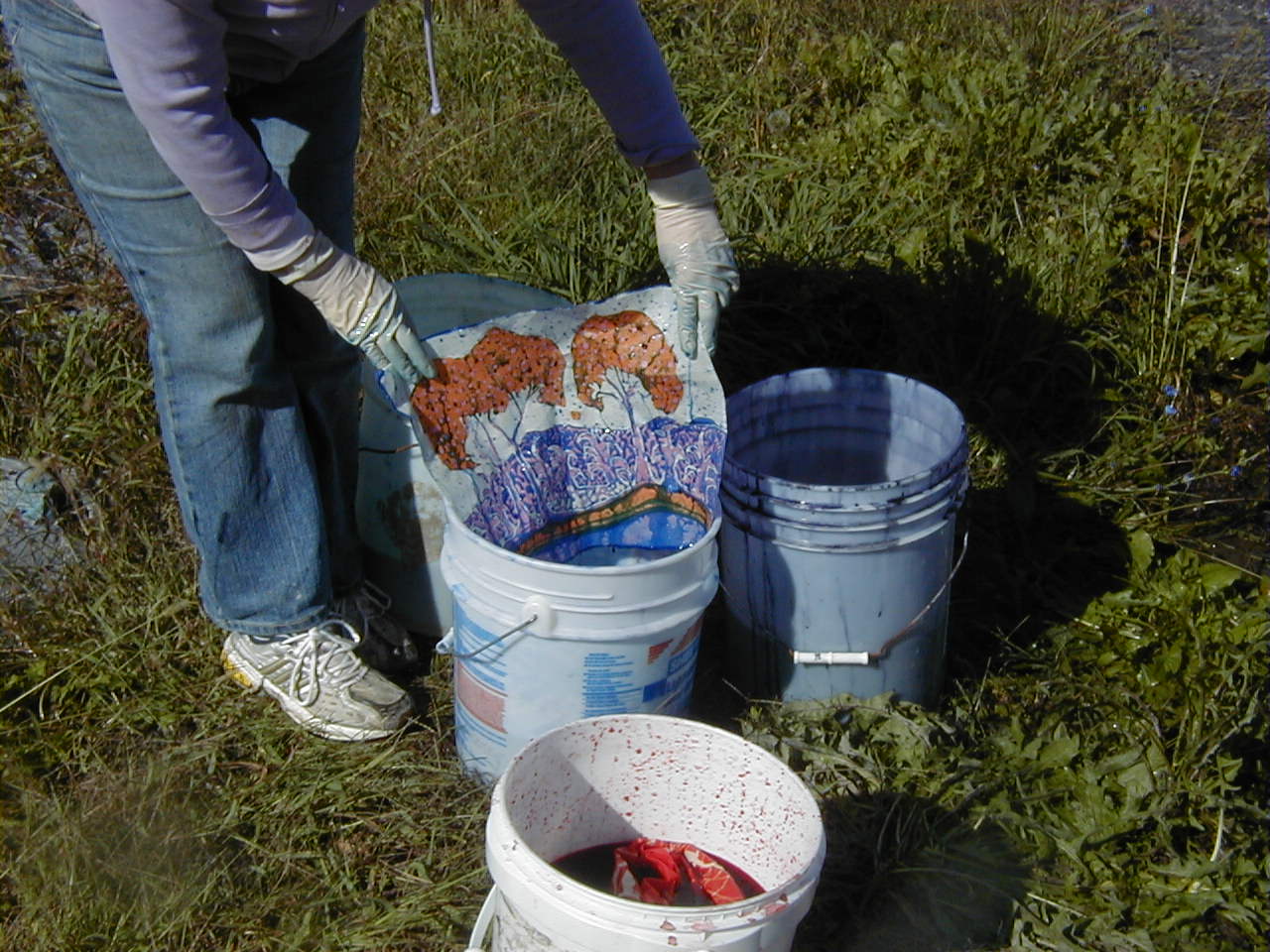
Dyeing is not so bad though. I actually love to dye fabric. Back to basics of fabric. Before any artwork is done on cloth it must be scoured with detergent in hot water to remove any sizing and shrink it. Natural cotton is the fabric I use for most my batik but I also paint on silk, a more delicate fabric. After the first stage design has been painted or applied with a tjanting I wet the fabric before immersing in the dye bath. Once in the dye bath the fabric needs to be gently moved ( gently so as to not damage the wax). See my last post for information on mixing dye. The temperature for batik is slightly warm for best absorption of color without melting the wax. Cold water may be used, but the colors won't be as bright and it will need to be in the dye bath much longer. The color should be checked when stirring and realize the color will appear much lighter when dry.

Soda ash must be added to the dye bath to activate the dye. A formula for 1 pound of fabric is;

3 gallons of warm water, 1 tablespoon dye, for more intense colors, 2 tablespoons dye and 3 to 4 tablespoons for very dark colors such as black and navy. Plain salt is added at 3 cups and increased with darker shades. 1/3 cup of soda ash is also added and 2 teaspoons of calsolene oil makes for better dissolving of dye. Once the soda ash is added, the life of the dye is limited by a few hours, so be sure to be ready to dye! For light colors the fabric can stay immersed for 20 minutes to half an hour. A dark shade would benefit from an hour or more in the dye bath. A large piece of fabric or several pieces can be dyed in the washing machine, just keep control so as to not have the dye spun out prematurely.

When the color has reached a darker shade than you feel you want, it is time to rinse out the excess dye. I like to rinse in an old sink outdoors (see photos of my Flower sink and the day lillies to go with it!)I also like to dye fabric in the warm months outdoors so I can spill and not have a speckled home. Rinse, rinse and rinse. Then let dry. the cloth may lie flat or hang on a line ( some separating of color can occur while hanging so be careful). For dark colors a slower drying helps to keep the color brilliant. Put the fabric in plastic for a very slow dry. When dry apply the next stage of wax with brush or tjanting to the areas you want to remain the newly dyed color, and repeat the process.
An alternative process to adding soda ash to the dye is to leave it out of the dye bath but soak the fabric in a soda ash mix, let drain an then immerse in the dye bath. This method allows the mixed dye a longer life. Urea added also increases the life of dye. You should be able to dye many smaller pieces over about a week, instead of all at once.

I use small and large tubs to dye in and have a long flat plastic container for large pieces that I don't wish to have crumpled, which could result in excess crackling of the wax. Most my summer work is quite large in size, taking advantage of the space in the great outdoors. In the winter I work on smaller pieces as well as scarves and purses that only need small tubs to be dyed.

My supply sources are http://www.dharmatradingcompany.com/ in San Rafael, California,which has a tremendous selection of dyeing supplies and fabric as well as good directions in their catalog. Also http://www.prochemical.com/ , Somerset, Massachusetts also a large selection of dyeing supplies. They also sponsor some excellent workshops. workshops@prochemical.com. Both have good technical advice available.

See the photos to see me dyeing some of my large pieces. Always be aware of the translucent nature of dye. Each color is affected by the previous colors. The images pictured are in the middle stages of completion. I will have more on the batik process in future posts. Meanwhile I hope this imformation helps. Happy Dyeing!


Sunday, June 12, 2011

Mixing Dyes


It is satisfying to see the garden plants stretch out and grow. About the yard this time of year, things change everyday. The Iris were beautiful and now gone, but poppies and beauty bushes have new blossoms every morning.I like to take note in the morning of each new flower, bud, and the condition of all in the yard. I am struck by the thought that nothing will ever be the same as it is today and if we don't stop to look at what is there, it will be forever gone.

I turn from the outdoors and get set to mix my dyes. I usually mix a selection of colors that complement a group of batik with a similar theme and color scheme. Mixing dyes is not my favorite task, but dyeing batik is.

I'm working with Procion fiber reactive dyes. These are the best for dyeing batik, as the color actually binds to the fabric and they work as cold water dye. This is important as batik need to have a cool temperature (95 degrees to 110) to maintain the wax on the batik. Hotter temperatures will soften and even melt the wax on the batik, destroying the design. The temperature can be cooler, but the dyeing process will take longer. Very cold temperatures will cause excess crackling of the wax, but beeswax is less likely to crack. Most often I use a mix of parafin and beeswax.

These dyes are in powder form, and it is best to wear a dust mask when mixing several batches. Colors are handled differently. Darker, more intense colors, require more volume of dye (2x to 3x as much) and also salt, than lighter colors.

I use a measuring cup and small amount of warm water to "paste" the dye. Next, very hot water is added to blend the dyes, stirring constantly, untill all is dissolved. Salt and fabric softener are also dissolved and added to a pail of lukewarm water.The dissolved dye is strained through a thin old cloth to catch any flecks of dye. More hot water is repoured through the dye on the cloth so none is wasted. Red is an especially difficult color to mix. Calsolene oil is helpful in dispersing the color bursts.

The dyebaths are put in large plastic pails and a few are in longer shallow trays ( good for larger pieces where crackling is not desired.) Colors in the dyebaths can last about a week, especially with some urea added. Once the soda ash (washing soda) is added, the dyes have a life of several hours only.The soda ash is needed to activate the dye and if I've mixed enough dye to do pieces for several days, there is an alternative method to use. The fabric can be soaked in a seperate soda ash bath and drained prior to adding to the dyebath. this gives the dyes more time to be used, however, each piece of cloth added removes some dye particles until the colors get paler and finally become exhausted.


I've included some pictures of a small tree batik before and after dyeing. Also shown is my large horse batik being waxed with a tjanting, and then held up after being dyed in red.


Just a few more colors need mixing and I'll..........Oh no!My yearling heifer, Footstep has slipped through the fence. The old fence controller has failed. I walk over to my calm peaceful heifer and she's decided it's nice to be out. As I approach to put on a halter, she gives her head a toss, turns with a leap and runs off across the newly mowed field of alfalfa north of our house. Nothing will be dyed today.

Monday, June 6, 2011

Magic Frogs Rising - part of the Larac members show


My Large batik (26"x 39"), "Magic Frogs Rising" is now at the Lapham gallery at the Larac members show in Glens Falls, New York. It will be running through June 21.
You can see the batik in the long shallow dyebath, many pictures of the finished work still covered with wax, and finally covered with paper, a small section revealed with the wax ironed out.

I'm including an image of the batik and some detail shots as well as a few pictures of it in progress. Limited edition prints of this image are available through etsy or email me at carollawconklin@yahoo.com

Amity Farm - Early Days


Thinking back to those days long ago on Amity Farm......... Spring! the air filled with the sweet smell of blossoms and new mown hay, Looking up the hill with the sun filtering through a multitude of fairy beds. Early morning, going to get the cows off pasture was heaven on earth . Showing pictures today from, husband, Dick on the old International tractor, chopping the corn for winter silage. Our hutch calves on high with Adirondack balloons floating by. A young calf peaks out of our old calf shed. Here I am my favorite spot. Daughter, Jaka, has freed up the hay elevator, again and is very happy about it. So were we! Those are days of inspiration for me.

Tuesday, May 31, 2011

Memorial Day Memory


Spring has evolved to what now seems like summer and the month of May is at the end. Memorial Day has passed, but it will always be an anniversary of when we moved to Amity Farm in Hartford, New York at the foothills of the Adirondacks.

My Morgan mare, Amity (means friendship), gave her name to our jersey cow dairy. Such a beautiful farm filled with wonderful memories. See photo here of Amity with her baby daughter, Maya. The pictures show our herd greeter, Sadie, cows grazing below trees with barns and house in background, me, feeding a baby calf, and my husband,Dick, on the tractor baling hay and happy to be harvesting early spring feed for our jersey cows.

Tuesday, April 26, 2011

Cold but Beautiful


It has still been freezing here and sooooooooo far behind last year, when pasture arrived early in April. The grass is green at last and heavy rain arrived last night pounding on our windows and earth below. The forsythia bushes have finally donned their bright cheerful yellow and glow, as do daffodils here and there. I've been cleaning up the large yard after winter's onslaught as well as picking up the cow manure and hay in the pasture area close to the house, now piled here and there to added to a larger pile and then break down to return to the earth, good rich earth!
The mountains and fields today are highlighted with sun patches and cause me to think of the land over time. How many generations have looked on this before, and how many will in the future. How much change has taken place, even in the woods there are stone walls built to clear land to fields that now have returned to trees. We borrow land to live on or farm here in Washington County NY. The land is for us to use in this life, but must be kept well for future generations. Farms in this county are concerned with preserving the land at it's best. I am fortunate to be able to have such beauty to inspire my artwork in my backyard.